

Manuel Marino - Music, Arts, People, Ideas

History of Music and Current Recording Industry Crisis

March 21st, 2008

Roger L. Bagula wrote this exclusive article for ManuelMarino.com.

History of Music and Current Recording Industry Crisis

In a time when the whole future of how music is distributed is in question, maybe we should look at the history of music for a guide.

Many of us find music is a part of our everyday life; both in terms of listening and making it. I have an egroup on the archaeology of prehistoric men. Music seems to have been part of what distinguishes men for other beats. The discovery of a bone hollowed out to make a flute by Neanderthals has made many speculate that music is one of the oldest “preoccupations” that didn’t actually produce survival rewards.

We picture men with low foreheads sitting around the campfire playing bone flutes and beating on hollow logs. The man who was good on the flute had to be subsidized by the other hunters. In the Sahara Arab culture the women are the make the music. There are ancient Egyptian drawing of people playing stringed instruments, The god Mot is said to have had music in his temples. The ancient Greeks had a very well developed theory of 5 tone music as well.

In the European tradition what is called “church music” was actually scripted in a staff in 8 tones during the medieval era. In both church and secular life music was an everyday entertainment and some people spent their lives as singers in the Jewish Cantor tradition. At this time a distinction between “holy” and profane (dance) music seems to have been made.

The age of reason gave us Bach fugues and well tempered music with twelve major tones instead of just 8. Keyboard instruments appeared in churches and the drawing rooms of the rich and famous. Europe was a center of world culture in the arts and sciences with university courses being taught in music theory.

Revolt against this almost always pleasant sounding music turned up in the form of Schönberg and his ideas of twelve tone sequences. Others experimented with expressionism and what they called “tone color” in trying to match the music and art of a puzzling modern world.

But little known to the European intellectuals a new music form came to life in America based on a African folk form and being fostered by the black community quite by itself. Jazz was a free form music where chord forms called progressions were used and many of the people playing the music couldn’t read sheet music at all. It involved syncopation, drums and rhythm fugues as well as multi-melodies in an ad lib setting. It was involved in moods as the blues and dance in terms of swing and jitter-bug and was considered profane in many white communities. Until recording and radio it was pretty much played for free in clubs where blacks went at night . But even as simple as the chord progression were it displaced classical forms in the hearts of most of the world’s population in less than 50 years form Rag time in 1900 to the 1950’s Rock and Roll. In the materialistic society success came with money and records by these artists sold so well that they became the new rich of the 20th century.

In the ’60’s I met a black sargent (hard stiriper) in Army who did this odd kind of poetic singing that he called rap. We all scorned him because we knew that Rock and Roll was king and it was here to stay. Again out of the sub-community of the black in a America and off shot of funk music used as backing for this rap singing came out of seeming nowhere in the 90’s to become a real musical movement world wide. The poor black was angry: he had been promised “equal rights”, but he got welfare and lingering on street corners while dope dealers preyed on him and his community.

Urban renewal meant that he was shoved out of his generational neighborhoods so that up town whites could have new condos closer to work. Gangs took control of streets and whole communities and had shooting wars while the mostly white police forces hid in their substations until the shooting stopped. As far as I know there has been little reform in response to this widely popular music style and the angry and profane words involved.

Another trend in music has been multi-tonality. Everyone knows listening to a slide trombone that there are an infinite scale of notes possible to music. Mostly we think in terms of a scale based on powers of two. The twelve tone scale came about when the Greek pentatonic scale was rationalized with the church 8 tone scale. Adding an C flat and an F flat (or two more sharps) seems to even out the keyboard in 14 tones instead of 12. The Arab musical intellectuals who were influenced by ancient Indian musical theory added twelve “between” tones and special Indian like tuning forms. To western ears Indian and Arab music has a unique blue or “color tonal” feel to it that is attractive to a mind tired out by a limited tone scale of 12 tones.

In the early 20th century an electronic instrument called a Theremin was invented using the electronics that came with shortwave and AM radio. This instrument involved producing tones of all kinds of sine waves. By the 50’s this kind of music found it’s way into science fiction classics as Alien music.

In the 60’s with the use of computers the digital slicing and dicing of sound had started. The result as we all know is the compressed digital sound file called the mp3, but electronic music had become more than this ! From digital midi sequencing and interfaces that captured keyboard notes as score notes on an electronic staff to distortion electronics that could make a guitar sound completely different with feedback and reverberation effects, new music that had never been heard by human ears before was being invented and circulated. Like rap music, it wasn’t at first very easy to get such music to the mass audience, but the European “House” dance music of night clubs began to change that in the 80’s. Here a century long decline in European music began to turn around, so that the German school of electronic music is a leader in innovation and Americans seem to be trailing behind?

The conversion of the CD digital formate files (Aiff and wave) to mp3 in the 90’s by Classic Mac SoundJam which was taken over by Mac and called iTunes made upload of digital files to the Internet easy. People began to share their favorite music internationally. Downloads of digital music even at several megabytes each became very common.

The recording Industry being on the back end of this movement and historically behind in the innovation curve was caught unprepared. They began suing private citizens (college students who are the poor). For the rich to be openly prosecuting the poor for the crime of “downloading” became the democratically most unpopular move in ages.

It is the royalty money from the sale of recoded media that has made the new music rich like the Beetles. The failure of recording industry executives to find a way to plug this hole in revenues seems to signal a decline in such music as a way of passing music around that has been popular since the 1920’s and AM radio started it off. Before that it was sheet music that passed the music from one place to another.

The result of this crisis is that we are faced with a change in how music is given to the public. From my own experiences the recording industry corporate model hasn’t been a perfect one. We are looking at an art form where their are several kinds of artists who need to support their families: composers, performers and song lyrics writers. If these people “suffer”, then the listeners will be affected shortly after in not being able to get music that they want.

Survival and eating are usually a little above making music on the daily calendar.


Your Ad Here


My personal collection of book trade ephemera

March 11th, 2008

Benjamin Clark is the Curator of Education for the Oklahoma Museum of History. Benjamin wrote this exclusive and very interesting article for us. He retains copyright of the first image and the text, of course. The second image is in the public domain.

My personal collection of book trade ephemera


My personal collection of book trade ephemera is *supposed* to focus on the book trades of the frontier. I have to remind myself of that every once in a while. But I’m almost always a sucker for beautiful typography. Am I the only collector who gets sucked down tangents? I doubt it.

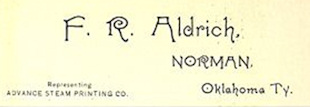
I’ve had a business card for a while for one FR Aldrich, an agent for Advance Steam Printing Co. in Norman, Oklahoma Territory. The Aldrich card is one of my favorites, because of the frontier association and for the simple beauty of the typography.

Now, Norman was founded and occupied the night of the initial land run into the Unassigned Lands April 22, 1889. Oklahoma became a state in November 1907. That date range was the closest I could get to FR Aldrich and his business. An 18 year gap is a little too big for me for someone really not all that long ago or far away.

I tried Googling the name F.R. Aldrich, thinking Aldrich would be an uncommon enough name to locate easily. I did find lots of Fr. Aldriches, as in Father Aldrich, and I did find a couple FR Aldriches. One was a female college student in the 1940s on the east coast; others had too little info for a positive ID. But one suspect turned up in Kansas in 1913 and 1916 and was a school district superintendent. He (?) could be the same person. Not much difference in time and location, but a little bit of a career shift. Then again, I’ve already uncovered more than one barber/ bookseller. I could see how connections to publishing and printing could be useful as a school superintendent.

I turned my attention to identifying the font used for the main text. I hoped the font would help me date the card. Printers like to use new hip typefaces in their advertisements, an opportunity to show off new faces and technical capabilities. This was truer in the past than it is now. If I can get the actual name of the face, maybe I can track down a date and get closer to figuring out FR Aldrich’s story. Today, thanks to the charter member from Michigan of the American Book Trade Index, I found another example of this cool, odd font in a directory ad for a newspaper in Ann Arbor Michigan from 1892.


The 1892 date of the directory is spot on for the range I had established of 1889-1907. I’ve run through the resources of the Oklahoma Historical Society for FR Aldrich and the Advance Steam Printing Co. without any luck, although someone is chasing one last idea down. I ran the FR Aldrich card through What the Font , a website you can upload .jpg files and the website searches out the closest match for your font. The first time I ran the card through none of the “matches” were even close. Admittedly, the image of the card isn’t very sharp, and there just aren’t that many letters to work with, especially letters that would be totally unique to this type face. I ran the Ann Arbor Democrat ad through, and What the Font matched it very closely to a face called Trapeze Normal. Very cool. Almost.

The problem is that there are several computer fonts called Trapeze. That and computer fonts are not the same as printing typefaces. I can’t seem to find the historic typeface’s name it is based on. It’s a lead and perhaps one more piece of the puzzle. Maybe just a piece of a piece.

But, Emma E. Bower caught my eye. Now, it really was not uncommon for women to be editor/ publishers of newspapers in the U.S. In fact, women had been in charge of presses from the very earliest presses in North America in 1639. However, in many cases, these women were widows taking full control over the family printing business. They would often operate under their husband’s name, or under initials.

Googling Ms. Bower reveals some tempting tangents. First of all, she is Dr. Emma E. Bower, M.D., of Port Huron, St. Clair County, Michigan. Not only a Democrat, but a Delegate to Democratic National Convention from Michigan, in 1920. She served as Secretary of the Ladies of the Maccabees, an insurance/ fraternal organization for women only, from 1893 until at least 1919. The Knights of the Maccabees claim them as an auxiliary organization at least well into the 1920s. The Ladies of the Maccabees said they started out as such, but had become “wholly independent” after a couple short years. Her name also appears with some mentions of the suffrage and temperance movements, but I couldn’t find any specifics or print sources I could access for more info. She certainly sounds interesting!

So, from the Land Run in Oklahoma to a suffragette in Michigan. Stupid, wonderful tangents…


Your Ad Here


Add to Technorati Favorites


Click here to join manuelmarino
Click to join My Yahoo Group


BookCloseouts is the bestseller of bargain books on the internet. BookCloseouts.com has been in operation for over 10 years selling books all over the world, with over 5 million books, and new inventory received every day. Exquisite oil-on-canvas limited edition masterworks of fine art by artists such as Claude Monet, Vincent van Gogh, Pino, Howard Behrens and many more. World's largest selection of sheet music, songbooks and guitar tabs: 456000+ sheet music titles, scores, methods and more. ArkivMusic is dedicated to making Classic Music easily available to the broadest possible customer base at very fair prices. They have the largest number of classical titles available in the U.S. currently. LucasArts is an American video game developer and publisher. The company was famous for its line of graphic adventure games, although today it mainly publishes games based on the Star Wars franchise. Musician's Friend, the World’s Largest Music Gear Company, offers over 40,000 products on their website. Products offered include guitars, basses, keyboards, percussion, amps, as well as recording, mixing, lighting, and DJ gear. Hundreds of new products are added monthly. Buy.com is a leading e-commerce company focused on providing a positive shopping experience and a broad selection of high-quality technology and entertainment retail goods at very competitive prices. They offer over 2 million products in categories ranging from computer hardware & software to electronics, books, movies / dvds & videos, music / cds & downloads, sports, games, toys, bags, baby, home & outdoor. NewOnlineShopping.NET is a new and elegant Weblog with interesting online shopping articles, stories and reviews of Clothing, Jewelry and Computer Shops.